



How To Fix A Door That Won'T Latch?
A door that will not latch usually has a misalignment problem between the latch bolt and strike plate. The cause may be loose hinges, a sagging door leaf, frame movement, excessive weather-strip pressure, an incorrectly positioned strike, or a damaged lock body.
The most reliable repair begins by finding where the latch contacts the strike. Enlarging the opening immediately may hide the real cause and weaken the hardware area.
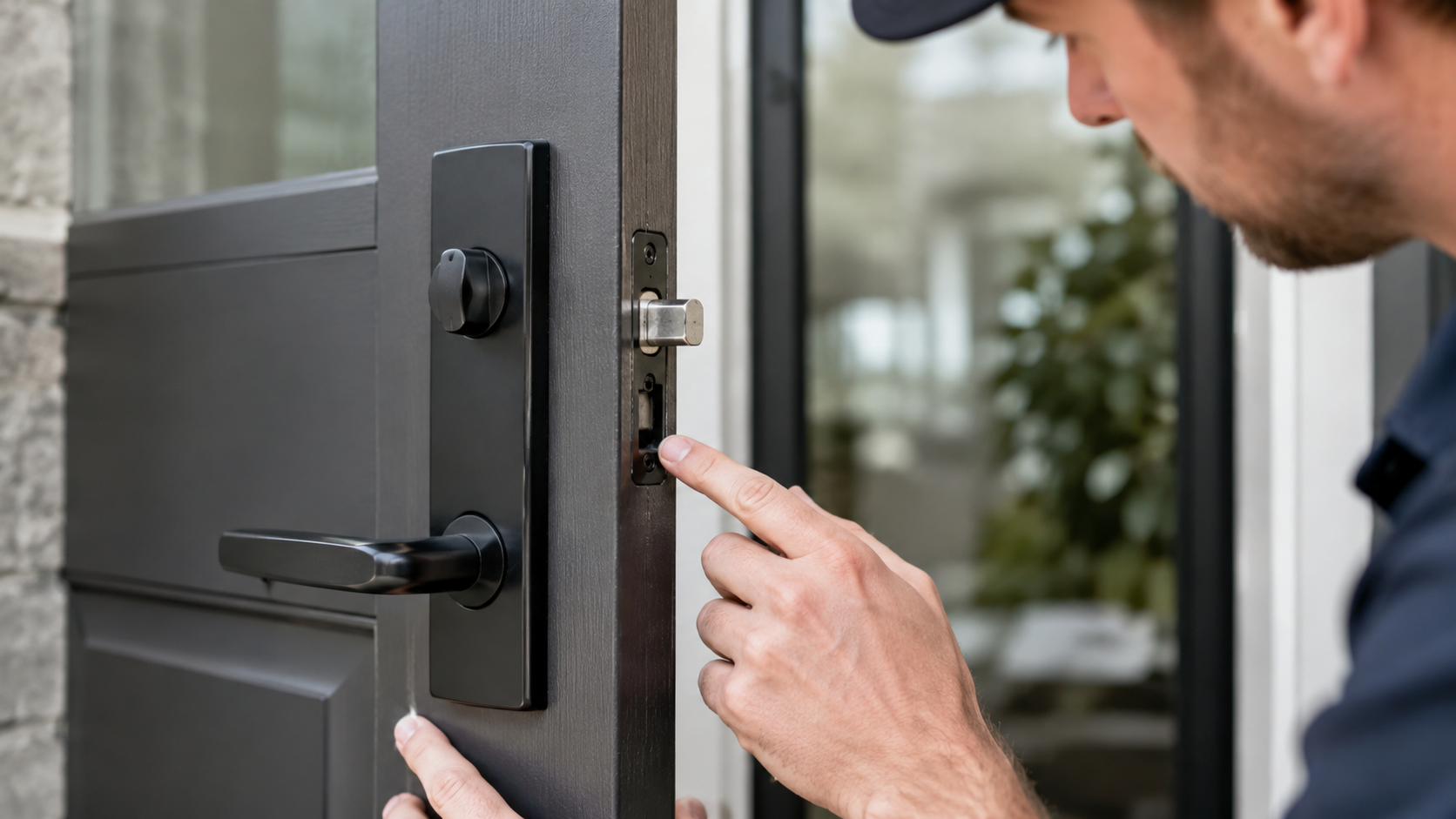
Table of Contents
- Observe the Door Instead of Forcing It
- Tighten the Hinges First
- Check the Door Gaps
- Test the Weather Stripping
- Adjust the Strike Plate Carefully
- Determine Whether the Lock Body Is Damaged
- When the Door Latches but the Deadbolt Does Not
- Why Factory Frame Accuracy Matters
- Submit a Door Alignment Enquiry
Observe the Door Instead of Forcing It
Close the door slowly while watching the latch side.
Listen and feel for the point where movement stops.
Then check:
Does the latch hit above the strike opening?
Does it hit below the opening?
Does it contact the inner or outer edge?
Does the door close when lifted by the handle?
Does it latch when pushed firmly?
Is the problem worse in humid weather?
Did it begin after new weather stripping was installed?
These observations reveal whether the door has moved vertically, horizontally, or inward relative to the frame.
Apply removable marking material to the latch bolt when necessary. Close the door gently and inspect the transfer mark on the strike plate.
Tighten the Hinges First
Loose hinge screws are a common cause of a sagging door.
Open the door and check every screw in the frame and leaf. Tighten them with the correct tool while supporting the door.
When a screw spins without tightening, the fixing point may be stripped. The repair method depends on whether the frame is timber, steel, stainless steel, aluminum, or composite.
Do not insert random oversized screws into a metal security-door frame. The replacement must match the threaded insert, reinforcement plate, or structural fixing point.
Inspect the hinge itself for:
Bent leaves
Worn pins
Loose welds
Cracked mounting areas
Excessive vertical movement
Corrosion
Missing fasteners
A heavy entrance door should not be supported temporarily by one damaged hinge.
Check the Door Gaps
Stand on the opening side and compare the gap around the complete perimeter.
A properly aligned door normally shows a controlled, consistent gap. Warning signs include:
Narrow gap at the upper latch corner
Wide gap at the lower latch corner
Door rubbing at the threshold
Hinge-side gap changing from top to bottom
Frame bowing inward
Leaf contacting one seal much earlier than the others
If the complete frame has shifted, moving the strike plate alone may not solve the underlying problem.
A local installer may need to check anchors, shims, wall movement, and frame square.
Test the Weather Stripping
New or oversized seals can prevent the door from reaching the latch position.
Close the door while applying gentle pressure near different sections of the frame. When one area feels unusually firm, inspect the gasket.
The seal should compress evenly. It should not fold, twist, overlap at corners, or push the door away from the strike.
Do not remove the complete seal simply to make the latch work. The correct solution may involve:
Repositioning the gasket
Trimming an incorrect corner joint
Selecting a lower-profile seal
Adjusting the threshold
Realigning the strike
Correcting frame distortion
Exterior doors need both reliable latching and continuous weather sealing.
Adjust the Strike Plate Carefully
When the hinges, frame, and seals are stable, a small strike adjustment may correct the problem.
Mark the original position before loosening the screws.
Move the strike only enough to center the latch within the opening. Keep the plate level and use suitable fixings.
Avoid grinding or filing a large section from a security strike. This can reduce the contact area around the latch or deadbolt.
For a multipoint locking system, all hooks, bolts, rollers, and keeps must align together. Adjusting one point without checking the others can make the handle difficult to operate.
A locksmith or entrance-door technician should service complex multipoint systems.
Determine Whether the Lock Body Is Damaged
Operate the handle and latch while the door is open.
The latch should extend and retract smoothly. A slow, loose, or partially retracting bolt may indicate:
Internal spring failure
Spindle damage
Loose handle connection
Contaminated lock mechanism
Bent latch bolt
Incorrect cylinder installation
Failed mortise lock body
Do not spray an unknown lubricant into a complete lock system. Some products collect dust or affect internal materials.
Use only the maintenance method approved for the lock.
When the Door Latches but the Deadbolt Does Not
The latch and deadbolt use different strike openings.
A door may latch normally while the deadbolt contacts the frame because the door is not fully seated, the deadbolt strike is misaligned, or the frame has moved.
Do not force the key or thumbturn. Excessive pressure can bend the bolt or damage the cylinder.
Check the closed-door position, seal compression, and frame alignment before altering the deadbolt opening.
Security Doors with multiple locking bolts require precise preparation. On-site cutting should remain a last resort rather than a routine installation method.
Why Factory Frame Accuracy Matters
Our factory manufactures customized entrance doors rather than relying only on standard-size door blanks.
As a custom steel front door frame wholesale supplier, we coordinate the door leaf, frame, hinge, strike, lock body, threshold, seal, and opening direction from the approved drawing.
Our production support includes:
Non-standard opening sizes
Reinforced lock and strike zones
Stainless steel and aluminum frame options
Multipoint locking preparation
Inward and outward opening
Laser-cut hardware openings
CNC-controlled dimensions
Automated forming
Pre-assembly inspection
Project-specific packaging
This integrated approach helps reduce strike misalignment, oversized site cutouts, uneven gaps, and repeated adjustment after installation.
Submit a Door Alignment Enquiry
Send us the wall-opening dimensions, door type, frame depth, lock specification, hinge direction, threshold details, finish, quantity, and installation country.
Our team can prepare a frame-and-hardware proposal with technical drawings, OEM/ODM customization, sample review, dimensional inspection, installation references, and export packing.
Previous: How To Fix A Hole in A Door?